
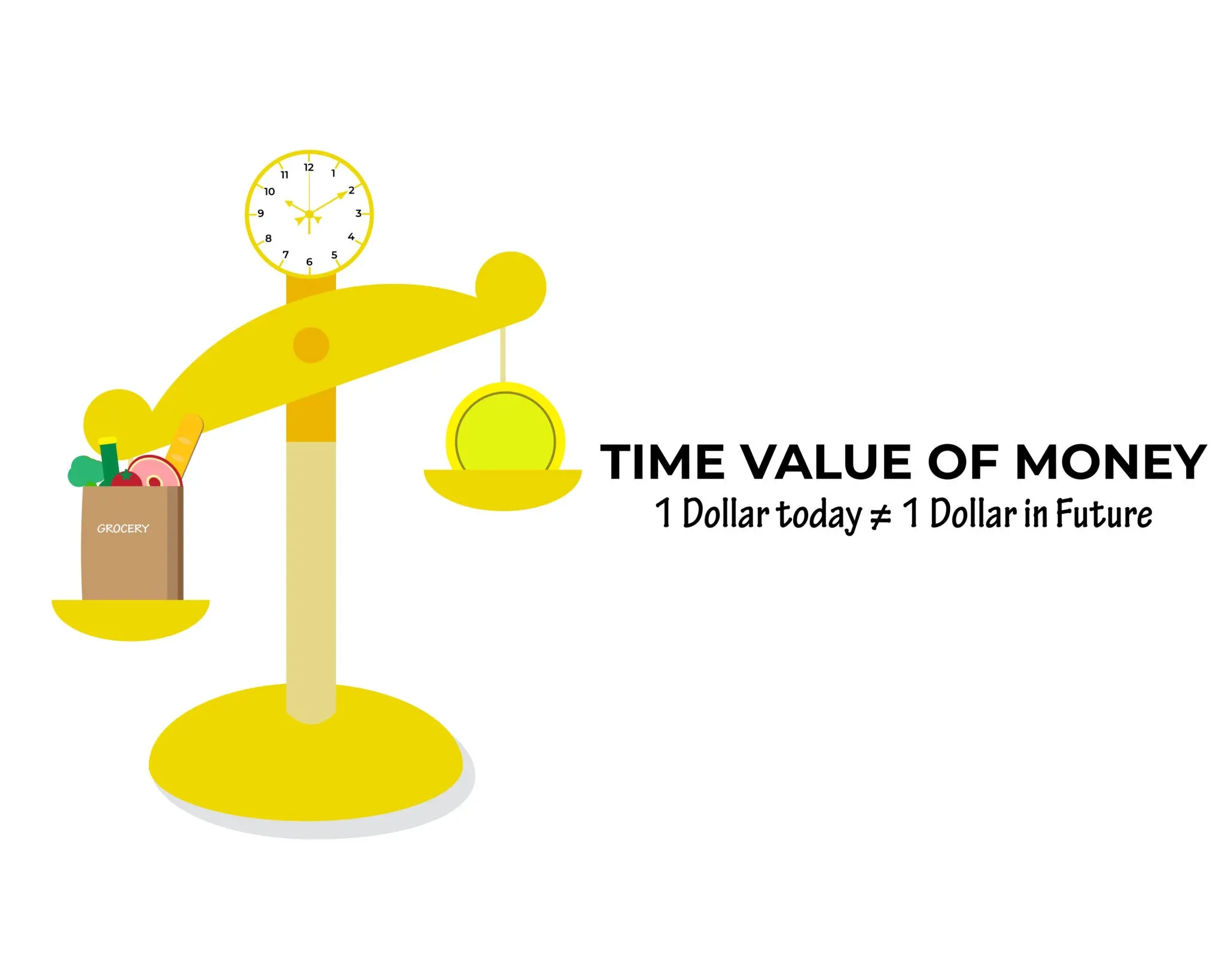
In today’s world, more people are becoming aware of the importance of saving and investing. However, there is one fundamental concept that is often overlooked: money does not have a constant value.
Think about something you bought a few years ago. Have you ever felt surprised that the price is much higher today? If yes, you have already experienced inflation.
Inflation refers to the general increase in prices over time. This means that with the same amount of money, you can buy fewer goods or services than before. In other words, your purchasing power decreases.
So, what about money itself? Does its value change?
The answer is yes—money changes in value over time.
Besides inflation, another key factor is the interest rate. Interest rates fluctuate depending on economic conditions, especially macroeconomic factors. These changes influence how money grows or loses value over time.
This leads to an important concept called the Time Value of Money (TVM). It means that money today is worth more than the same amount in the future because of its potential earning capacity.
Key Formulas
-
Future Value (FV)
This formula calculates how much your money will grow in the future.
FV = PV × (1+r)n
-
Present Value (PV)
This formula calculates the current value of money you will receive in the future.
PV = FV / (1+r)n
Where:
-
FV = Future Value
-
PV = Present Value (initial money)
-
r = interest rate per period
-
n = number of periods
-
Compound Interest
Compound interest shows how your money grows when interest is added repeatedly.
A = P × (1+r)n
Where:
-
A = final amount
-
P = principal (initial investment)
Example Application
Imagine you invest 10,000,000 IDR with an annual interest rate of 5% for 3 years.
Using the Future Value formula:
FV = 10,000,000 × (1+0.05)3
FV = 10,000,000 × 1.157625
FV = 11,576,250
This means your money will grow to 11,576,250 IDR after 3 years.
Now, let’s reverse it using Present Value. If you want to have 11,576,250 IDR in 3 years:
PV = 11,576,250 / (1.05)3
PV = (1.05) 311,576,250
PV = 10,000,000
This shows that 10 million today is equivalent to 11.57 million in the future at a 5% interest rate.
Why It Matters
Understanding the time value of money helps you:
-
Make better investment decisions
-
Evaluate loan and saving options
-
Protect your money from inflation
Without this knowledge, you might think your money is growing, while in reality, its value could be decreasing.